The campsite makes the mountains less complicated
The good thing about a fixed base camp is not that the adventure becomes smaller. It is that the everyday logistics become easier. You can leave changes of clothes, food and spare equipment in the motorhome or caravan, carry less during the day and meet the evening with dry clothes, cooked food and a proper place to sleep.
For anyone new to the mountains, it is a friendly way to start. For families, it gives room to shorten the walk when legs run out. And for experienced walkers, the campsite can open several trails on the same trip, without everything having to fit into one long route.
Choose your base by the trails, not only by the view
A good mountain campsite is not necessarily the highest or most dramatic one. It is where you can actually reach the walks you want to do. Look at the distance to the trailhead, whether parking is needed for the next stage and whether there are shorter alternatives when the weather comes in.
In Dalarna, STF Grövelsjön and Fulufjälls Camping can work as starting points for very different mountain settings. Farther north there are, among others, Funäsdalens Fjällcamping and Edsåsdalens Camping in Jämtland, plus Camp Kittelfjäll and Tärnaby Camping & Stugby in Västerbotten. Treat them as starting points in your planning and always check current opening hours, booking terms and trail information with each site.
Plan the day walk as if the weather will change
In the mountains, a clear morning can turn cold, windy and wet before the coffee thermos is empty. Check the mountain weather on the same day, choose a route for the least experienced person in the group and set a clear time when you turn back, even if the summit is still tempting.
Tell someone where you are going and when you expect to be back. Have a map that works without mobile coverage and pack rainwear, a warm layer, hat, gloves, food, water and something extra for an unexpected pause. Base camp gives reassurance after the walk, but it does not come with you onto the bare mountain.
The best rhythm leaves room for a rest day
It is easy to turn hiking into a programme: one trail on Monday, a summit on Tuesday, the next valley on Wednesday. But the mountains are often better when the schedule has a gap. A rainy morning can become a long breakfast, a short walk and time to check boots and kit instead of a reluctant full day in wet clothes.
Choose, if you can, a campsite whose surroundings also work when legs want to rest. Closeness to a village, a lake, a mountain station or simply a sheltered place for supper helps the trip hold together even when the day’s big walk is cancelled.
Fire, tents and freedom need some thought
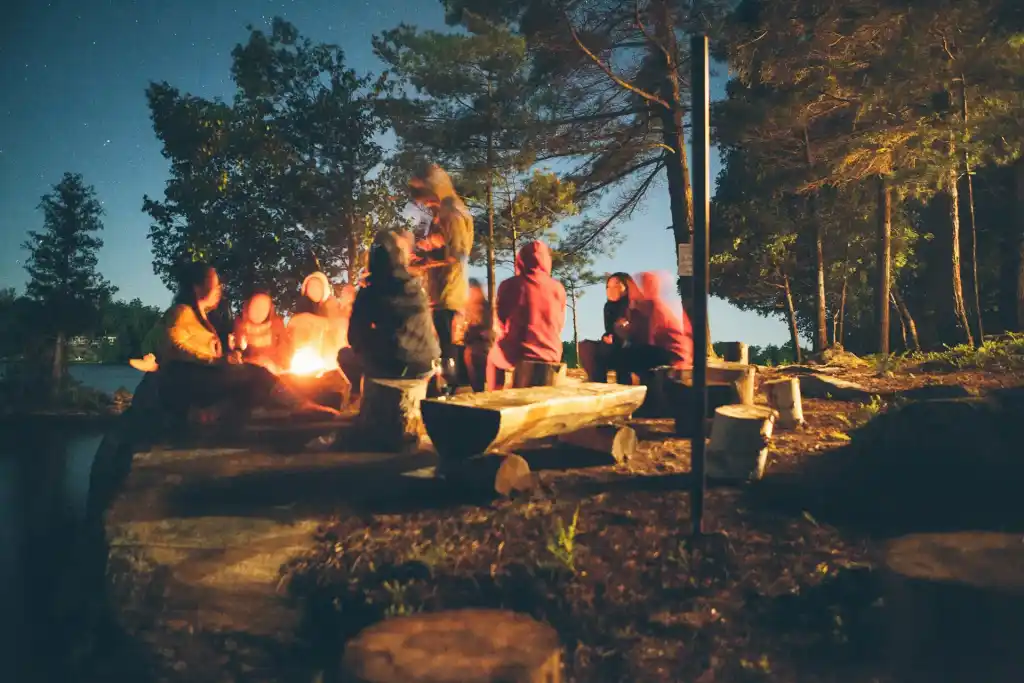
An evening fire belongs to the camping dream, but not to every evening. Use a designated fireplace, check local rules and current fire bans, and avoid fires completely when the ground is dry or the wind is strong. The warm camp feeling in the image is lovely, but safety must always come first.
If you want to leave the campsite for a night in a tent, the right of public access applies with responsibility and consideration. Do not pitch close to homes, avoid sensitive ground and find out what applies in national parks and nature reserves, where special regulations can limit both tent camping and fires.
Pack for two kinds of day
Base camp does not mean you need to bring the whole store cupboard, but a few things make a big difference: a daypack that fits well, dry spare layers, first aid, blister plasters, a head torch and a simple plan for how wet gear will dry by the next morning.
Let the campsite carry its part of the trip too. Fill water, charge what needs charging and prepare tomorrow’s packed lunch in the evening. Then the next day can begin with the zip of the tent, the door of the motorhome or the caravan’s little step, and then only the sound of boots on the trail.