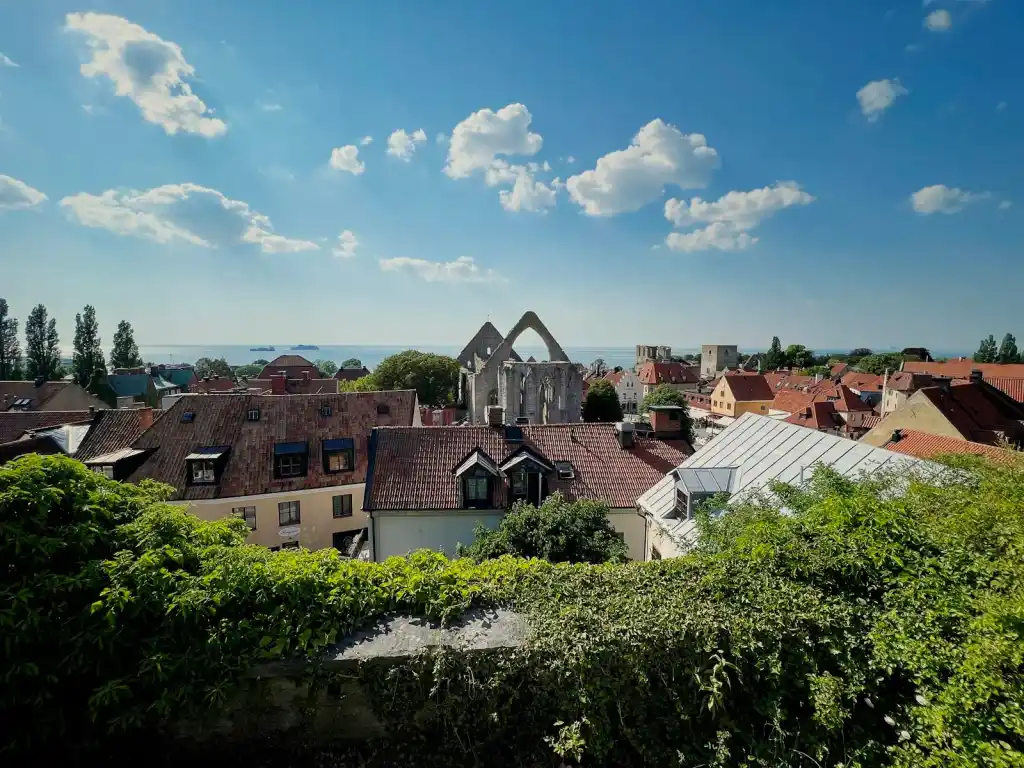
Arrival: Visby inside the ring wall
Few Swedish destinations make an entrance like Gotland. The ferry glides towards Visby, the ring wall rises limestone-white against the sky and suddenly the mainland feels far away. This is where most motorhome trips begin, and the town can handle more than an afternoon. Inside the wall wait lanes with climbing roses, dramatic ruined churches and a harbour promenade that comes alive when the evening sun turns the stone pink.
For the motorhome, the area around Visby is unusually convenient. If you want to sleep close to the ferry and inner town, there are central stopovers with a short route to both the harbour and the town’s services, practical when the trip begins or ends with a city day. If you prefer family energy to the medieval setting, the larger campsites are just south of town, beside summer and water parks, making the first night as easy for the children as for the driver.
The west coast: sunsets and swimming in Tofta
Drive south from Visby and you soon reach Gotland’s sunny side. Tofta beach is the island’s classic, shallow, chalk-white and facing straight west, which means sunsets that make the whole car park fall quiet. Motorhome travellers gather here for swimming, ice cream and beach restaurant within walking distance, and the area has both full-service campsites and simpler stopovers close to the sand.
The good thing about the west coast is that it works at two tempos. If you stay at a campsite, you get shower, electricity and a base for several days of beach life. If you choose a stopover close to the swimming, you get a lighter stop where the evening is about the sea and tomorrow is about rolling on. Either way, remember that the best west-coast spots fill quickly in July, so arriving early afternoon is a good habit.
Northwards: Lummelunda, limeworks and the road to Fårö
Northern Gotland is austere, beautiful and full of traces of the island’s industrial history. Along the west coast you pass Lummelunda Cave, one of Sweden’s best-known stalactite caves, and the landscape opens into limestone slabs and twisted pines. Small-scale stopovers around Stenkyrka and Lummelunda make good bases for anyone who wants to explore the cave and coastal road without rushing.
Farther north you reach Bläse, the old limeworks by the sea, where a lakeside stopover sits among industrial memories and sea-stack landscape. It is a place for the traveller who would rather have history and horizon than reception and pool. From here it is not far to Fårösund and the ferry across to the island’s most mythical excursion destination.
Fårö: the island of sea stacks
The short, free ferry across to Fårö feels like a border between two worlds. On the other side waits Ingmar Bergman’s island: sea-stack fields at Langhammars and Digerhuvud where the limestone stands like sculptures at the water’s edge, miles of beaches such as Sudersand and a light that film directors have travelled the world to capture. It is no wonder Fårö has become a symbol of all Gotland.
For motorhomes, Fårö works best as a calm couple of days rather than a quick sweep. There are stopovers in guest-harbour settings close to the sea and campsites near the big beaches, but service is more spread out than on the main island, so have water and tanks in order before you cross. The reward is evenings where the only sound is the wind in the pines and the waves against the sea stacks.
The east coast: Ljugarn, Folhammar and quieter Gotland
When you turn back south and cross the island towards the east, the trip changes character. The east coast is Gotland’s quieter side: Ljugarn is the island’s oldest seaside resort with sandy beaches and summer charm without city pulse, and just to the north Folhammar’s sea stacks rise from the water in one of the most beautiful stack fields outside Fårö. This coastal stretch is made for bike rides, morning swims and late dinners in the long light.
Motorhome places here are often on the edge of the communities, close to both swimming and sights such as medieval churches and sea-stack landscapes. The pace is lower, distances short and competition for places milder than on the west coast, a rewarding area to put in the middle of the trip when you want to settle properly before the road turns home.
The south: Hoburgen and the road back
Gotland’s southern tip is the island’s wilder ending. Here the land narrows towards Hoburgen, the lighthouse and the red sea-stack figure guarding the southern cape, and the landscape feels more remote and dramatic. Campsites and adventure villages around Burgsvik and Fidenäs make good bases for anyone who wants to explore the south without driving back and forth to Visby every day.
This is also where many finish the loop around the island before steering back towards the ferry terminal. It is worth adding a final night with margin before departure: a calm morning by the sea is a better final scene than a stressed drive to the harbour.
How to plan the motorhome loop around Gotland
Think in a loop, not back and forth. Gotland is just the right size to drive anticlockwise or clockwise over one to two weeks: Visby and the west coast, up to the north and Fårö, down along the east coast and home via the south. Short stages make the biggest difference; the island opens up when you stop chasing kilometres.
Mix campsite and motorhome stopover according to need. Campsites are gold when the children want to swim all day or when tanks and battery need a proper refill; stopovers shine when you want to stand close to a swimming spot, harbour or sea-stack field for just one night. Book popular coastal locations in advance during high season, and always keep a backup place in your back pocket. Open the map, filter for what you need for the evening, and let Gotland handle the rest.